

Written September 28, 2026 – 8 minute read
Some Sponsors may treat predicate selection as a citation exercise in the entire process of bringing a medical device to market: finding the most similar device, building a similarity and differences comparison table, filing a submission, receiving premarket clearance from the FDA, and then finally commercialization. In reality, predicate selection is more like an acquisition, since a Sponsor adopts another company’s predicate intended use statement, their technological envelope, their risk profile, and their regulatory history. The Sponsor must then defend all of it during the FDA review of the device’s 510(k) premarket submission.
There are four ways that a Sponsor’s predicate selection can and will go wrong that will be discussed in this post: 1) split predicates, 2) recall history, 3) predicate creep, and 4) the risk of Additional Information (AI) requests.
1) Split predicates: Banned for a Decade, still Submitted Every Month
Split predicate means that the Sponsor demonstrates that your device has the same intended use as one marketed device (Predicate A) while comparing its technological characteristics to a second device (Predicate B) with a different intended use. FDA’s 510(k) substantial equivalence (SE) guidance states directly that use of a split predicate is inconsistent with the 510(k) regulatory standard. Based on the 510(k) Decision-Making Flowchart below, in order to achieve a Substantial Equivalence(SE) decision all five Decisions (1- 5) must be established with a single device.1
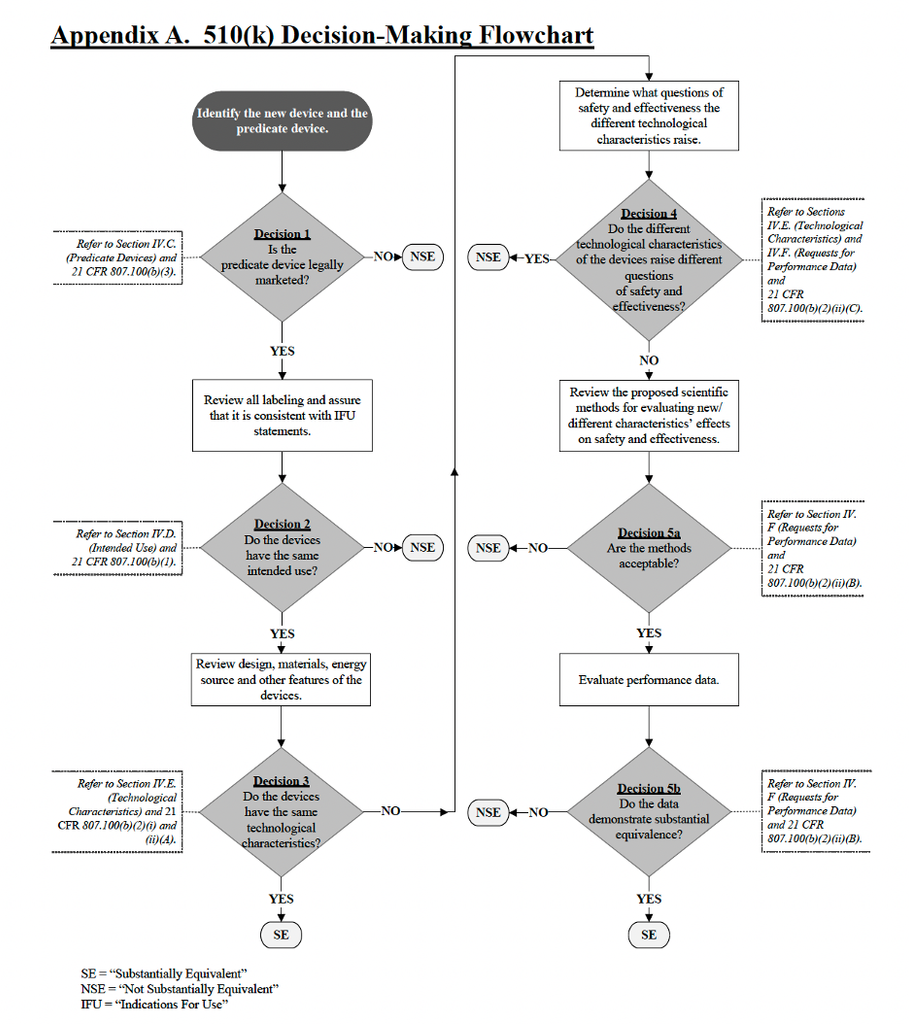
Figure 1 – Substantial Equivalence Flowchart from FDA guidance on 510(k)’s1
A cautionary example of split predicates is DePuy’s ASR XL metal-on-metal hip system (K080991)2, that was cleared by FDA against multiple predicates but none of which combined all three of its distinguishing characteristics, and subsequently resulted in the product being recalled in 2010.3
A “split predicate” is never declared in a 510(k) submission. However, the split predicate may be there but disguised in the submission. For example: The Sponsor is using Predicate A for the indication and Predicate B for the energy source. Or: Predicate A establishes the clinical claim, and Predicate B establishes the algorithm that controls the function of the device. If the second device does not share the device’s proposed intended use, you have built a split predicate regardless of what you call it.
Multiple predicates remain legitimate, sometimes the best option is to combine features from two or more devices with the same intended use or seeking more than one indication under a single intended use, with a primary predicate designated. Reference devices are also legitimate, but their job is narrow: supporting scientific methodology or standard reference values, after substantial equivalence has already been carried by the primary predicate. In practice most sponsors now label a second device a reference device rather than a secondary predicate, largely to avoid the split-predicate question. A secondary predicate is only used when a device is not used to establish substantial equivalence.4
If the only way to bridge the Sponsors proposed device with predicates with different intended uses is via the De Novo pathway.
2) Recall history: Legally Permitted, Practically Costly
FDA’s September 2023 draft guidance on predicate selection proposes four best practices: choosing a predicate cleared using well-established methods, one that meets or exceeds expected safety and performance, one without unmitigated use-related or design-related safety issues, and one without an associated design-related recall.5 FDA recommends considering reported adverse events, malfunctions, or deaths associated with the candidate, and has indicated that where problems surface, sponsors should select a different valid predicate.6
Two things to hold at once.
- A recalled device that remains legally marketed is still a legally valid predicate, and FDA cannot reject your submission on that basis alone.
- But it will cost the Sponsor anyway, since inheriting the design feature that triggered the recall, and your comparison table now has to explain why the same characteristic is acceptable in your device. This attracts unwanted attention and risk much greater scrutiny for your product and any complaints or events that reported for it.
ACI’s recommendation is to always run a MAUDE search for (potential) predicate devices, also review the recall database, the TPLC reports, and warning letter history on every candidate before you commit to a primary predicate, and document that you did and your firms’ evaluation. This will be required anyways for your devices 510(k) summary where FDA asks sponsors to include a narrative explaining how the predicate was selected and the rationale for its substantial equivalence.7
3) Predicate creep: the Debt Compounds Behind You
Predicate creep is the accumulation of small, individually defensible steps. Generation one clears against a 2014 device. Generation two clears against generation one with a modest material change. Generation three adds a sensor. By generation six, the marketed device has little functional relationship to the technology the classification regulation actually describes. Three exposures follow from this.
First, your substantial equivalence argument is only as sound as the weakest link behind it. If a reviewer walks the chain back a gap three generations upstream becomes your problem to explain, using a 510(k) summary written by a company that may no longer exist or a product that is no longer on the market.
Second, Your product code and classification regulation may no longer fit. Special controls added after your original predicate cleared still apply to you. Devices routinely sit in regulations that predate their technology entirely, that works until a reviewer decides it does not, and then you are arguing classification rather than equivalence.
Third, your labeling drifts faster than your clearances. Marketing language changes and may drift across generations until the promoted intended use has quietly moved past anything that has ever cleared. That is no longer a premarket problem, it is a misbranding problem, and it arrives as an untitled letter or an “It has come to our attention” rather than an Additional Information (AI) request.
4) The lazy choice becomes an Additional Information request
The most common failure is not exotic. It is choosing a predicate because it was easy to find, because it belongs to your own company, or because a competitor’s marketing made it visible rather than because it is genuinely closest to your device.
The consequence is mechanical. The reviewer identifies the technological differences you glossed over, asks for testing you did not perform, and places the submission on hold, sometimes putting the submission back to square one. You lose the remainder of the MDUFA clock plus your response time, and if you need new bench or clinical data, the hold will most likely outlast the 180-day window, and the submission will be withdrawn.
AI-triggering issues tied to predicate choice are predictable. They include indication language that doesn’t match the predicate’s cleared indications; technological differences without bridging performance data; new standards that post-date the predicate so conformity was never shown; predicates with public summaries too thin to support a credible comparison; and predicates cleared under a different regulation or product code than the one in your submission. What makes this expensive is that the remedy is usually a different predicate which means rebuilding the comparison, possibly regenerating test data, and refiling.
Best Practices: What disciplined predicate selection looks like
Identify a candidate set, not a candidate. Screen each against the three to four draft best practices even though they are non-binding, and write down why one predicate won and the others lost. Build the full comparison table before you commit, because the table is where the undisclosed testing burden becomes visible. Where the technological gap is non-trivial, confirm the predicate and the test plan in a Pre-Submission rather than betting a review cycle on your own reading. And stay willing to conclude that the honest answer is a twelve-month De Novo beats two failed 510(k) cycles (2 years+) and a withdrawal.
Predicate selection is not always treated with the seriousness it deserves.
References
Sources are listed in the order the supporting claims appear.
Substantial equivalence and split predicates
- FDA, The 510(k) Program: Evaluating Substantial Equivalence in Premarket Notifications [510(k)] (final guidance, July 2014). https://www.fda.gov/media/82395/download
- DePuy Orthopedics, Inc. DePuy ASR XL Modular Acetabular Cup System. K080991. https://www.accessdata.fda.gov/cdrh_docs/pdf8/k080991.pdf
- BONEZONE, “FDA Clarifies Substantial Equivalence Requirements for 510(k) Submissions,” 2014. Source for the DePuy ASR XL split-predicate example, citing the underlying New England Journal of Medicine analysis. https://bonezonepub.com/2014/09/09/fda-clarifies-substantial-equivalence-requirements-for-510k-submissions/
- Hyman, Phelps & McNamara, “Choice of Secondary Predicate versus Reference Devices in a 510(k) Submission,” FDA Law Blog, September 2022. Source for the practical drift toward labeling second devices as reference devices. https://www.thefdalawblog.com/2022/09/choice-of-secondary-predicate-versus-reference-devices-in-a-510k-submission/
Predicate selection and recall history
- FDA, Best Practices for Selecting a Predicate Device to Support a Premarket Notification [510(k)] Submission (draft guidance, September 2023; Docket FDA-2023-D-3134). Status confirmed as draft, “not for implementation,” as of September 2026. https://www.fda.gov/regulatory-information/search-fda-guidance-documents/best-practices-selecting-predicate-device-support-premarket-notification-510k-submission
- Innolitics, “FDA Webinar Notes: Predicate Device Selection and Use of Clinical Data.” Source for FDA’s stated recommendation to select a different valid predicate where adverse events or problems are identified. https://innolitics.com/articles/fda-webinar-notes-predicate-device-selection-and-use-of-clinical-data/
- StarFish Medical, “Using the FDA’s Best Practices for Selecting a Predicate Device.” https://starfishmedical.com/resource/using-the-fdas-best-practices-for-selecting-a-predicate-device/
Databases to screen candidate predicates
FDA MAUDE — Manufacturer and User Facility Device Experience database. https://www.accessdata.fda.gov/scripts/cdrh/cfdocs/cfmaude/search.cfm
FDA Medical Device Recalls database. https://www.accessdata.fda.gov/scripts/cdrh/cfdocs/cfRes/res.cfm
FDA Total Product Life Cycle (TPLC) database. https://www.accessdata.fda.gov/scripts/cdrh/cfdocs/cfTPLC/tplc.cfm